How a Moroccan Mother, Amina Yabis: Built a Cooperative That Changed Thousands of Women’s Lives
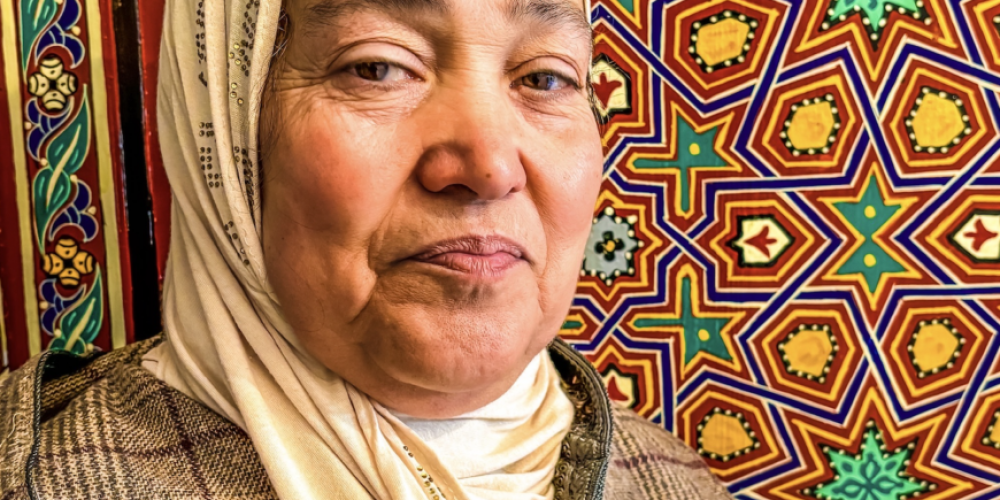
Amina Yabis, Owner Cherry Buttons Cooperative, Sefrou
But Amina Yabis is not just another artisan, she is the driving force behind the Sefrou golden buttons cooperative, and a powerful symbol of change in Sefrou, Morocco.
She’s famous for understanding something most people miss: that silk buttons, of all things, could become weapons against an economic system designed to keep women poor. That traditional crafts dismissed as “women’s work” contained genuine power when women controlled how that work was valued and sold. That one person, starting with almost nothing but determination and a clear vision of injustice, could reshape the future for thousands.
This is the story of how a Moroccan housewife, denied formal education, married to a schoolteacher earning a modest salary, raising four sons in a town tourism ignores, became a national figure by doing something radical: she refused to accept that things had to stay as they’d always been. She looked at generations of women earning a dollar a day for skilled artisan work and decided the system needed breaking. Then she broke it.
What she built, the Sefrou golden buttons cooperative, has become a model studied internationally, featured in museum exhibitions, and recognized by Morocco’s King. But the real story isn’t about recognition. It’s about the forty-two women earning sustainable incomes where none existed before. The 180 girls who learned to read through her literacy programs. The daughters staying in school because families can finally afford it.
Amina Yabis shows us how one woman’s vision can uplift an entire community.
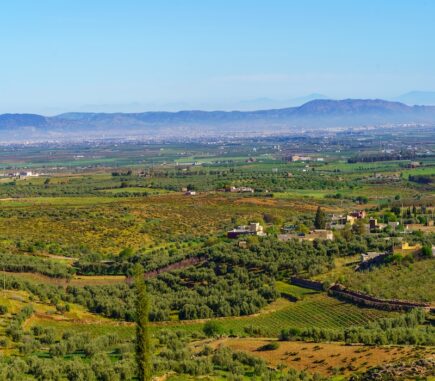
Sefrou, Morocco Landscape
The Town Time Nearly Forgot Amina Yabis: Sefrou and the Golden Buttons Legacy
Before we meet Amina, you need to understand Sefrou.
Drive thirty kilometers south from Fes into the foothills of the Middle Atlas Mountains, and you’ll find a town that tourism largely ignores. There are no grand riads converted into boutique hotels here, no restaurants with English menus, no carpet sellers aggressively pursuing foreigners through narrow streets. Sefrou exists for the people who live there—a rare quality in Morocco’s better-known cities.
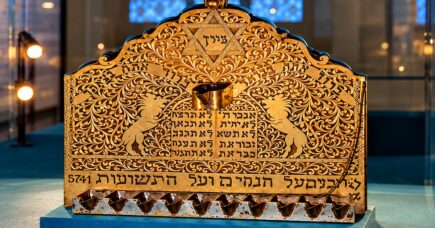
The old medina earned UNESCO recognition in 2013, not because tourists demanded it, but because the architecture and urban planning represent something historically significant: a place where Muslim and Jewish communities coexisted for centuries, sharing streets, markets, and most importantly for our story, craft traditions.
Jewish families dominated Sefrou’s button-making trade for generations until the 1960s, when most emigrated to Israel during the mass departure of Moroccan Jews. As they left, they taught their Muslim neighbors the intricate knotting techniques that had sustained their livelihoods. Skills passed between friends became the foundation for what would eventually transform women’s lives in this region.
The town celebrates its cherry harvest each summer with one of Morocco’s oldest festivals, another UNESCO recognized tradition. But cherries aren’t why travelers should know about Sefrou. They should know it because of a woman who understood something most people miss: that economic power precedes every other kind of freedom.
What makes meeting Amina rare isn’t just her story, it’s the access. She doesn’t open her door to casual tour groups or accept drop-in visitors. The time travelers spend in her kitchen exists because of relationships built over years with tour operators she knows and trusts. When guests arrive through our Morocco Mother-Daughter Tour, Amina welcomes them not as anonymous tourists but as connections—friends of friends. That distinction matters in Morocco. It’s the difference between a quick photo stop and spending 3-4 hours genuinely learning, listening, and understanding.
A Conventional Life That Wasn’t
Amina Yabis grew up in Fes learning gold thread embroidery, the kind of painstaking needlework that requires exceptional hand-eye coordination and infinite patience. Her family couldn’t afford to keep her in school, but that needle taught her something more valuable than any textbook: that skilled hands could create value, that craft could open doors poverty had closed.
She married Si Mohammed, a schoolteacher, and moved to Sefrou in the early years of their marriage. Four sons arrived in quick succession. On a teacher’s salary in a Moroccan town, money remained perpetually tight. So Amina did what countless women before her had done, she learned to make buttons.
Not just any buttons. The elaborate hand-knotted silk buttons that decorate traditional Moroccan clothing, djellabas, kaftans, wedding garments. Each button required specific knotting techniques creating intricate three-dimensional patterns from wound thread. The work demanded the same precision her embroidery training had developed.
Here’s what made the situation remarkable, and infuriating: In Fes, male button makers completed formal apprenticeships and joined recognized craft guilds. They learned from masters, gained official credentials, commanded respect for their artistry. In Sefrou, women taught themselves by watching other women, practicing alone, perfecting techniques without any formal training system because none existed for them.
Amina’s daily routine became a study in relentless efficiency. “Every day I got up at 5:00 in the morning, made bread and cooked the meals by 8:00 a.m., and worked on buttons until 5:00 or 6:00 p.m.,” she recalls. “I did it to educate my sons.”
She produced buttons in bunches of forty, selling them to tailors and merchants who would incorporate them into finished garments. For an entire day’s skilled work creating perhaps three or four bunches, she earned roughly one dollar. Meanwhile, those same tailors sold the finished garments for substantial profits, capturing the value her hands had created.
Some women would have accepted this as immutable reality—the way things had always been, would always be. Amina looked at this system and saw something different: theft disguised as tradition.
Sfifa Buttons Hand-made, Sefrou
The Education That Changed Everything
The catalyst came from an unexpected direction, her husband’s political involvement.
Si Mohammed participated in a Moroccan human rights organization focused on women’s rights. After attending meeting after meeting where men discussed women’s issues without any women present, he told Amina something that would redirect her entire life: “We work on women’s rights, we defend women’s rights, but not one woman comes to our meetings. The wife needs to be there too.”
So Amina started attending. She sat quietly at first, listening to men debate policies affecting women’s lives. She absorbed the rhetoric, the legal frameworks, the theoretical approaches to empowerment. And gradually, she understood that these conversations, however well-intentioned, missed something fundamental.
Women needed more than rights on paper. They needed economic independence—actual money they controlled, earned through their own labor, without filtering through husbands or middlemen. Everything else was theater without this foundation.
In 1994, Amina took an action that shocked Sefrou: she became the first woman in the town’s history to run for city council.
She knew she wouldn’t win. That wasn’t the objective. “I didn’t do that to win and get a job,” she explains. “No, I did that to show that a woman has the right to run in elections. She, too, can defend people’s rights, and she, too, has the right to stand for election, not just vote.”
The campaign taught her exactly what she’d suspected: without economic power, political influence remained impossible for women. She needed a different strategy—one rooted in the skills women already possessed and the unfair system that had exploited those skills for generations.
She needed to start with buttons.
Amina Yabis Page from Hand-made Button Book
Understanding the Craft: Why These Buttons Matter
Before explaining what Amina built, you need to understand the buttons themselves, what they are, how they’re made, why they represent more than decoration.
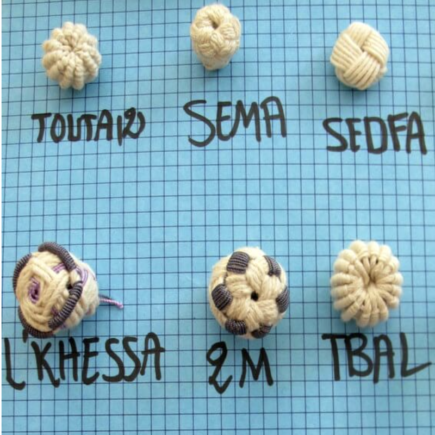
Traditional Moroccan buttons are three-dimensional sculptures in miniature, created entirely by hand using wound silk thread. Women knot the thread around small cores (historically made from paper or cardboard), building intricate geometric patterns that are both functional and beautiful. Applied in rows down the front of traditional garments, they serve as closures while adding ornamental detail that signals the wearer’s taste and the garment’s quality.
Each button style carries a specific name based on its appearance:
The bstilla resembles Morocco’s famous pastry—round and flat with elaborate surface stitching suggesting layered dough. The shems (meaning “sun”) radiates like light from a central point. The boushniqa evokes dried wildflowers. The semma mimics traditional embroidered slippers and remains Amina’s personal favorite—”the old ones that the Jews taught us,” she says, “the genuine article.”
Creating these buttons requires skills that take years to master. The thread tension must remain consistent or the pattern distorts. The knots must be placed precisely or the button won’t hold its shape. The finished product must be tight enough to withstand decades of wear and washing while maintaining its form.
Women working alone in their homes could produce between one and four bunches daily, each bunch containing forty buttons. An experienced maker working at maximum efficiency might complete 160 buttons in a single day, representing perhaps ten to twelve hours of focused skilled labor.
For this work, tailors paid women approximately one dollar per bunch.
Do the math. On her best days, producing four bunches, a woman earned four dollars. That’s roughly thirty cents per hour for artisan-level craftsmanship creating products that would last fifty years.
The tailors and merchants who purchased these buttons wholesale then sold the finished garments for hundreds of times what they’d paid the women who created the buttons’ value.
This was the system. Generations of women had accepted it because no alternative existed. Amina decided to create one.
Amina Yabbis Cherry Buttons Cooperative, Teaching Women
Building the Foundation: The Sefrou Golden Buttons Cooperative
Amina’s first challenge was bureaucratic. She discovered that forming a legally recognized women’s artisan association required navigating Morocco’s complex government paperwork, forms, applications, certifications, approvals from multiple ministries.
Though literate (itself unusual for women of her generation and economic background), she lacked experience with official documentation. She needed help, and timing delivered it: the U.S. Peace Corps had just launched a Small Business Development program in Sefrou, sending volunteers to assist local artisans with business organization.
Amina approached one of these volunteers and explained her vision, a women controlled association that would allow button makers to negotiate directly with buyers, eliminating exploitative middlemen. The volunteer helped navigate the paperwork. In 2000, Golden Buttons became reality, the town’s first women’s artisan association.
But Amina’s ambitions extended beyond buttons into something more transformative: literacy.
She launched an educational campaign teaching girls and young women to read and write Modern Standard Arabic (Morocco’s spoken Derija dialect has no written form and differs substantially from formal Arabic, making literacy a gateway to education, employment, and civic participation). Over five years, 180 girls and women learned to read and write through Golden Buttons’ program skills that would reshape their futures in ways beyond what any of them initially imagined.
The literacy project achieved its immediate goals and then faced an unexpected problem: success revealed limitations. Golden Buttons, structured as a nonprofit organization, couldn’t generate profit for its members. It could provide education and advocacy, but it couldn’t put real money in women’s hands, the economic foundation Amina knew everything else depended on.
Moroccan law allowed artisan cooperatives to operate as for-profit businesses, but every existing cooperative had been founded and controlled by men. Women could join as members, but leadership remained exclusively male.
Amina decided to break this pattern as she’d broken others.
Amina Yabis, Cherry Buttons Cooperative, Loom
The Cherry Button Cooperative: Rewriting the Rules
In July 2000, Amina founded the Sefrou Women’s Silk Button Cooperative, known locally as the Cherry Button Cooperative after the town’s symbolic fruit and the cherry-like appearance of clustered buttons.
The business model was straightforward but revolutionary in its implications:
First, Amina eliminated middlemen entirely. She traveled to Casablanca and Fes herself, negotiating directly with thread suppliers and tailors. This cut out multiple layers of markup that had previously enriched merchants while keeping makers poor.
Second, she paid women significantly more per bunch than tailors had offered. Not charity rates—fair compensation for skilled artisan work.
Third, she established complete pay equity. Every woman in the cooperative received identical payment for identical work. Experience, age, family connections—none of this affected earnings. Only output mattered.
Fourth, all cooperative members shared year-end profits equally. Success belonged to everyone who contributed to it.
Fifth, all financial records remained transparent, overseen by an accountant from Morocco’s Ministry of Handicraft. Every woman could see exactly where money came from and where it went.
Membership grew slowly at first. Married women needed their husbands’ permission to participate, and many husbands initially refused. Widows and single women joined first, proving the model worked. As these women’s incomes became visible, children attending school who couldn’t have before, household improvements, small luxuries previously impossible, skeptical husbands reconsidered. More women joined.
Then Amina made her boldest decision: the cooperative would stop simply supplying buttons to tailors and start creating finished products themselves.
They embellished scarves with button decorations. They created decorative pillows. They designed handbags and slippers featuring button patterns. Most innovative, Amina developed button jewelry—bracelets, necklaces, earrings using the distinctive buttons as the primary design element.
These products sold at craft fairs, first locally, then regionally. Women who had never traveled beyond Sefrou began representing the cooperative at markets throughout Morocco. Eventually, international opportunities emerged, craft shows in France, Spain, Italy, and ultimately the prestigious Santa Fe Folk Art Market in the United States.
The cooperative that had started with a handful of widows now employed forty-two women across Sefrou and surrounding villages. This is the cooperative model travelers engage with on our Morocco Mother-Daughter Tour, where the visit to Amina includes learning about how she structured profit-sharing and pay equity to ensure sustainable income for all members.
Amina herself contributed approximately 25% of her family’s income through the cooperative and her four sons all received the education she’d worked from dawn to dark to provide.
Women Artisans of Morocco, by Susan Schaeffer Davis
Beyond Economics: National Recognition
Amina’s success organizing women and developing community leadership attracted attention beyond Sefrou’s borders.
In 2006, she received a nomination for Khamisa, recognizing outstanding Moroccan businesswomen. The Museum of International Folk Art included the Cherry Button Cooperative in its exhibition “Empowering Women: Artisan Cooperatives that Transform Communities,” showcasing it as a model for sustainable development through traditional crafts.
Most significantly, King Mohammed VI appointed Amina as treasurer and board member of a new national center addressing women’s issues—a remarkable honor for a woman from a small town with no formal advanced education.
At this center, Amina’s work expanded into territories far beyond button-making: AIDS awareness, domestic violence prevention, family planning education. She brought the same grassroots approach that had built the cooperative, understanding that sustainable change emerges from within communities, led by women who know the challenges firsthand because they’ve lived them.
Amina’s story has also been chronicled in the book Women Artisans of Morocco: Their Stories, Their Lives by anthropologist Susan Schaefer Davis. The book celebrates 25 Moroccan women who practice traditional textile crafts-rug weaving, embroidery, button-making, highlighting their artistic skills, ingenuity, and strong roles in a traditionally male, dominated society as they contribute to their families’ incomes. Davis, who worked with organizations like the World Bank and USAID and first came to Morocco as a Peace Corps Volunteer in the 1960s, recognized Amina’s cooperative as a model worth documenting for its approach to economic empowerment through traditional crafts.
When asked what matters most about these achievements, Amina’s answer never wavers: “The most important thing is women. The co-op can sell more things and the world knows more about them.”
Not the international recognition. Not the prestigious appointments. Not her personal success. The women—their increased opportunities, their growing independence, their ability to shape their own futures.
Middle Atlas Couscous Rolling Workshop
A Morning in Amina’s Kitchen
The drive from Fes to Sefrou takes thirty minutes through landscape that shifts from urban sprawl to olive groves to the foothills of the Middle Atlas. By the time you arrive at Amina’s door mid-morning, the town is fully awake, women shopping in the market, children at school, men drinking coffee in small cafes that have occupied the same corners for generations.
Amina greets visitors at her door, and within seconds you understand something: she’s assessing you. Not with hostility, with curiosity. Are you genuinely interested, or are you collecting experiences? She can tell the difference, and it matters to her.
Her home reflects a life lived with intention. Everything is modest but carefully tended. The kitchen table where she teaches couscous rolling has hosted thousands of grains transformed into perfect spheres, hundreds of conversations about craft and worth and what women deserve. This is her classroom, her workshop, her domain.
She doesn’t start with her story. She starts with your hands.
The couscous lesson begins with observation. Watch how she does it, the wrist rotation, the finger pressure, the rhythm that looks effortless but requires thousands of repetitions to master. Now you try. Your first attempt produces clumps. She laughs—not unkindly—and places her weathered hands over yours, adjusting the pressure, correcting the motion. “Like this,” she says through the translator. “Feel it.”
This is when something interesting happens. The people who arrive treating this as a tourist activity—another box to check, another photo for Instagram—start to actually concentrate. Because the couscous won’t cooperate unless you do it correctly. And Amina won’t move on to the next part until you’ve gotten it right, or at least demonstrated genuine effort.
The conversation begins while your hands work. She talks about learning embroidery as a girl. About moving to Sefrou. About those years waking at 5 AM to make bread, cook meals, produce buttons until dark. She doesn’t present this as hardship deserving sympathy. She presents it as reality that required response.
“The system was designed to keep us poor,” she says matter-of-factly. “So we needed to design something different.”
It’s in these pauses, while semolina falls through your fingers and you try again—that visitors ask the questions they actually want answered. Mothers ask about balancing children and ambition. Daughters ask about starting something from nothing. Women ask about organizing, about resistance from men, about that moment when you decide to stop accepting how things are.
Amina answers everything with the same directness she brings to button-making: specific, precise, honest about what worked and what didn’t.
After couscous comes the buttons. She brings out baskets of brilliant colors wound into intricate patterns, evidence of hours of skilled labor by the forty-two women in her cooperative. You select colors to create jewelry. This part is easier than couscous, though the technique still requires attention.
What surprises visitors is the quality. These aren’t tourist trinkets mass-produced for foreign markets. These are heirloom-quality buttons that will last fifty years, created by women earning fair compensation for artisan work. When you string them into bracelets, you’re working with the same craftsmanship that decorates wedding kaftans and formal djellabas throughout Morocco.
Months later, travelers report glancing down at their wrists and remembering not just the activity but the conversation. The moment when Amina explained how she negotiated with skeptical suppliers in Casablanca. The story about the first woman whose husband finally agreed she could join the cooperative after he saw his children eating better. The quiet determination in her voice when she said, “Women’s work is only worth nothing if we accept that it’s worth nothing.”
Cherry Buttons Sefrou Cooperative Silk Threads
The Philosophy Behind the Buttons
Amina’s words about learning needlework as a girl reveal the operating philosophy that built everything:
“You know I’ve always liked all kinds of handwork. When I was a girl, I learned gold thread embroidery. Learning to use a thread and a needle changed my life. I didn’t go very far in school because my family was poor. But my craft gave me many things. It changed my future and my children’s. That’s why I tell women, any kind of work that you do, value and respect it, and it will give back to you.”
This isn’t aspirational rhetoric. It’s the business model.
Amina didn’t tell women to abandon traditional crafts and seek modern employment. She told them to value what they already knew how to do, to refuse to let others define that work as worthless, to organize so they could capture the value their hands created.
She didn’t argue that button-making was limiting. She proved it was liberating when women controlled how the work was valued, sold, and compensated.
She didn’t wait for systems to change. She built new systems alongside the old ones, proving through results that her approach worked better.
This philosophy, respecting and valuing women’s traditional skills while reorganizing how that work connects to economic power—extends far beyond Sefrou, beyond Morocco, beyond button-making. It’s about recognizing that transformation often comes not from abandoning tradition but from restructuring who controls and benefits from traditional knowledge.
Why This Matters Beyond One Woman’s Story
Amina’s achievement proves several things that matter beyond her personal triumph:
First, traditional crafts contain genuine economic power when women control the value chain. The Sefrou golden buttons cooperative proves this isn’t theory, it’s demonstrated reality. Forty-two families
Second, cooperative models can succeed in Morocco’s existing economic structures without requiring massive external funding or NGO intervention. Golden Buttons and the Cherry Button Cooperative operate within Morocco’s legal framework, paying taxes, maintaining proper books, following regulations. This makes the model replicable.
Third, women’s leadership works. Every major decision about the cooperative, what products to create, which markets to enter, how to price goods, when to expand—has been made by women. The results speak for themselves.
Fourth, economic empowerment and education reinforce each other. The 180 women who learned to read through Golden Buttons’ program gained skills that opened employment opportunities beyond button-making, while button income gave families resources to keep daughters in school rather than pulling them out to work.
Fifth, change doesn’t require permission from existing power structures. Amina didn’t wait for government programs or development initiatives. She organized women, navigated bureaucracy, built markets, and created sustainable income—proving that transformation often comes from individuals who refuse to accept that things must remain as they’ve always been.
Experience This Yourself
Amina’s story forms a centerpiece of our Morocco Mother-Daughter Tour, where the visit to Sefrou takes place on Day 4 of a 12-day journey designed specifically for mothers and daughters seeking authentic cultural immersion. The experience includes the couscous lesson, button jewelry workshop, and extended time hearing Amina’s story directly from her—not through sanitized tourist presentations, but in genuine conversation.
For travelers on our Women’s Luxury Tour of Morocco, the Sefrou visit exemplifies our commitment to women-led experiences that prioritize depth over surface-level tourism. These aren’t quick photo stops but substantial time with Moroccan women whose work is changing their communities.
Both tours are built on years-long relationships with Amina and other female artisans throughout Morocco, connections that allow us to offer access casual tour operators can’t replicate. When Amina welcomes our guests, it’s not as anonymous tourists but as connections through people she knows and trusts.
Bring your daughter, mother, sister, or female friend. While Amina welcomes all visitors, the experience resonates particularly powerfully for women traveling together—mothers and daughters, sisters, friends, because her story is fundamentally about relationships between women across generations and cultures.
The Real Morocco
In an era when “empowerment” has become marketing language and “authentic travel” often means carefully staged experiences optimized for Instagram, Amina Yabis represents something genuinely different.
She didn’t build the Cherry Button Cooperative because it was trendy. She built it because women were being exploited and she had the skills, determination, and courage to create an alternative.
She didn’t seek international recognition. It found her because the results of her work were undeniable—women who had been earning a dollar a day now earning sustainable incomes, girls staying in school because families could afford it, traditional crafts surviving because they generated real economic value.
She didn’t wait for systems to change. She built parallel systems that worked better, proving through results rather than rhetoric that women’s leadership produces tangible outcomes.
When you sit in her kitchen rolling couscous while she shares her story, you’re not just hearing about empowerment, you’re meeting it in person. You’re seeing what it looks like when someone decides that things need to change and then actually changes them, one button, one woman, one cooperative member at a time.
This is the Morocco worth discovering—not the sanitized tourist version, but the one where women are building futures with their own hands, where traditional crafts connect to economic power, where genuine relationships open doors that remain closed to casual visitors.
And it begins with the Sefrou golden buttons cooperative and a woman who understood that silk buttons.
Related Reading:
Meet Amina Yabis: Queen of Golden Buttons, Sefrou | Morocco Travel Blog
Add Your Heading Text Here
Lorem ipsum dolor sit amet, consectetur adipiscing elit. Ut elit tellus, luctus nec ullamcorper mattis, pulvinar dapibus leo.
Grow your report
Morocco Travel Blog is a vibrant online magazine showcasing Moroccan culture—from distinctive architecture and celebrated cuisine to colorful festivals and exclusive private travel experiences. Through engaging stories and stunning photography, it offers readers an insider’s guide to Morocco’s cultural heritage and contemporary life. With expert insights from its sister company, Travel Exploration Morocco, which specializes in curated private tours, the blog delivers authentic content that goes beyond typical travel guides.