A New Jewish Museum in the Mellah of Fes
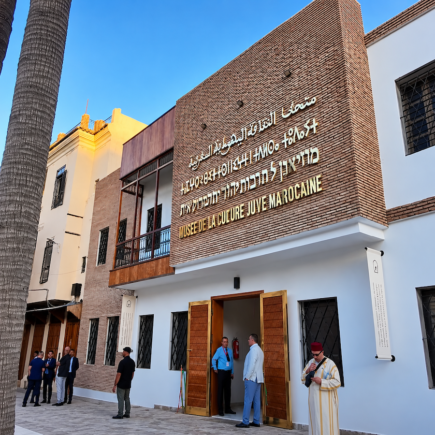
The museum sits in the Mellah, the Jewish quarter of Fes, founded in 1438 beside the Royal Palace in Fes Jdid. It is built on land donated by the Jewish community of Fes, in a building that once housed the community’s dispensary and kindergarten. The museum covers more than 1,700 square meters, about 1,200 of them exhibition space. Its interiors use zellige tilework, carved plaster, painted wood and a marble fountain. The brass inscription at the entrance is written in four languages: Arabic, Amazigh, Hebrew and French, a small detail that sums up the museum’s message. The inauguration on October 12 brought together Ahmed Toufiq, Morocco’s Minister of Endowments and Islamic Affairs; Khalid Aït Taleb, governor of the Fes-Meknes region; Mehdi Qotbi, president of the National Foundation of Museums; and Serge Berdugo, president of the Foundation for the Preservation of Jewish-Moroccan Cultural Heritage, along with diplomats and community representatives. King Mohammed VI launched the project in April 2019, as part of a program to restore the medina of Fes. Construction was completed in March 2023, and the museum was designed with input from the Moroccan Jewish community. The same program restored the Batha Palace, which reopened as a museum of Islamic arts. The two museums now tell connected stories: Jewish and Islamic traditions grew up in the same city, shaping its scholarship, crafts and trade.What’s Inside the Museum of Moroccan Jewish Culture
The permanent collection fills two floors in seven themed sections: Morocco as a meeting place of civilizations, the history of its Jewish communities, communal institutions, notable figures, family life, religious observance and traditional trades. A long timeline opens the visit. It runs from antiquity through the founding of the Mellah in 1438, the arrival of Jews expelled from Spain in 1492, and the mass emigration of the twentieth century. Highlights include:-
- Torah scrolls and silver rimonim, the ornamental finials placed on Torah scrolls.
-
- Ketubot, illuminated marriage contracts that blend Jewish law with Moroccan decorative style.
-
- The keswa el-kbira, the embroidered velvet “grand dress” worn by Jewish brides in Fes and other cities.
-
- Circumcision chairs, tallit bags and funerary inscriptions from synagogues and homes.
-
- Rare books, manuscripts and archives documenting rabbis, merchants and families.
-
- A reconstructed jeweler’s workshop, honoring the Jewish silversmiths who shaped Moroccan jewelry.
Highlights of the Collection, in Photos
Beyond the museum’s historical timeline and permanent exhibitions, individual artifacts reveal the artistry, religious traditions, and everyday lives of Morocco’s Jewish communities. The following photographs offer a closer look at several distinctive pieces and the cultural stories they preserve.
Hanukkah lamps and oil lamps
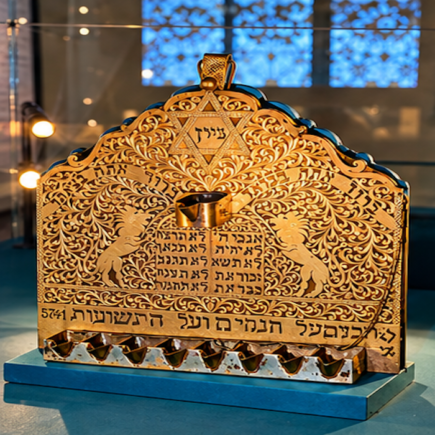
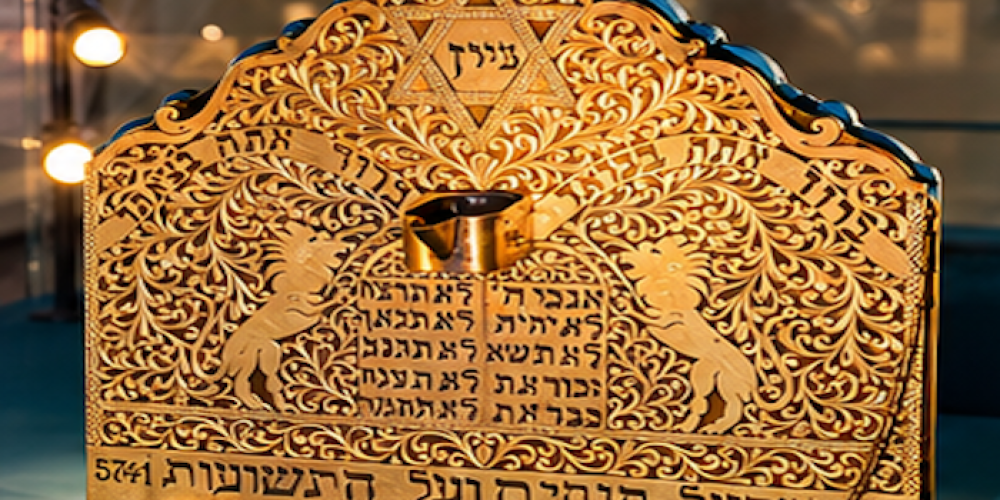
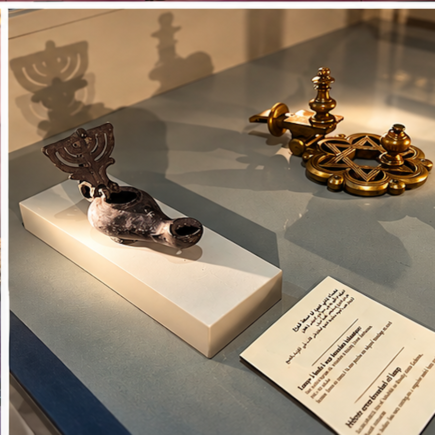
Moroccan Hanukkah lamps are among the most recognizable objects of Jewish North Africa. Most are made to hang on a wall, with a decorated backplate above a row of eight oil cups. Craftsmen worked brass, copper and silver into arches, birds, lions and the Star of David, often with Hebrew blessings engraved across the plate. The lamp shown at the top of this article carries the Hebrew words of the blessing recited when the candles are lit, flanked by two lions, and is dated 5741 in the Hebrew calendar (1980–81). Nearby, a small oil lamp with a menorah-shaped handle shows how far back the tradition of light goes.Ceremonial dress and embroidery
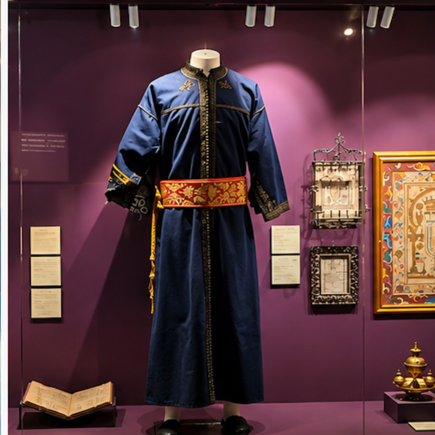
Clothing is one of the museum’s strongest sections. Embroidered robes, tunics and hooded cloaks show how Jewish dress in Morocco drew on the same regional styles as Muslim and Amazigh dress, while marking religious occasions and family milestones. Much of the embroidery was done by Jewish women and tailors, whose skills were known across the country.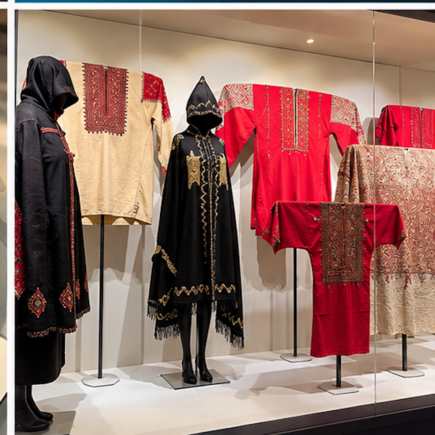
Ritual objects for prayer
Gold-thread embroidery, a specialty of Fes, decorated the bags that held a prayer shawl or tefillin. Pieces like this were often made for a bar mitzvah or a wedding and passed down through families.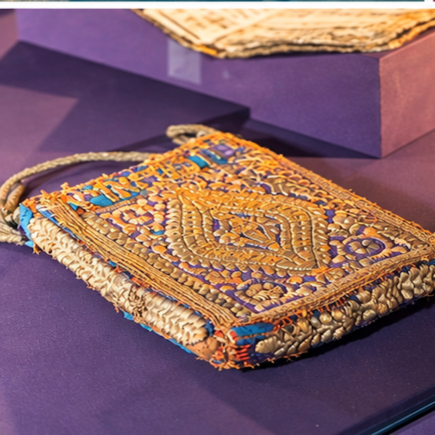
Household life: the tea table
Brass samovars, kettles and tea urns sit beside a blue-glazed Fes plate. Mint tea was as central to Jewish homes as to Muslim ones, served on Shabbat afternoons, at holidays and to every guest. Objects like these show how much daily life the two communities shared.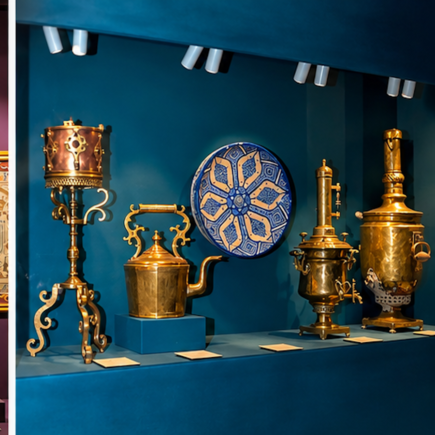
The Mellah of Fes: Six Centuries of Jewish History
Fes was one of North Africa’s great centers of learning, and its Jewish community was part of that. Maimonides, the medieval philosopher and physician, lived in Fes in the twelfth century before settling in Egypt. After 1438, the Mellah grew into a dense quarter of synagogues, yeshivas, workshops and homes with wooden balconies, still visible today. Jewish life there had periods of protection, autonomy and prosperity, but also restrictions and outbreaks of violence. The museum’s timeline treats both sides of that history rather than a simplified story of harmony.Jewish and Muslim Heritage in Morocco
Jewish communities once lived across Morocco: in Fes, Marrakech, Meknes and Rabat, in ports like Essaouira, Tangier and Tetouan, and in Amazigh villages of the Atlas and the southern oases. Some descended from ancient North African Jewish communities; others from Sephardic families expelled from Spain and Portugal. They spoke Judeo-Arabic, Amazigh languages, Haketia (Judeo-Spanish) and Hebrew. Jews and Muslims shared markets, crafts, music and food. Jewish musicians helped carry the Andalusian musical tradition. Mimouna, the Moroccan Jewish celebration at the end of Passover, is still marked with Muslim neighbors bringing flour, milk and honey. Morocco’s 2011 Constitution names the Hebrew heritage as one of the components of national identity. Since then, the country has restored dozens of synagogues and Jewish cemeteries. The Fes museum is the largest step yet.Why This Museum Matters for the Moroccan Jewish Diaspora
Most of Morocco’s Jewish population emigrated during the twentieth century, to Israel, France, Canada and the United States. Many families still keep the melodies, recipes and Judeo-Arabic expressions of their grandparents. For them, the museum shows the objects their ancestors used: wedding dress, ketubot, prayer shawl bags, silverwork. Combined with a visit to an ancestral synagogue or cemetery, it turns family history into something you can see and touch. Our Jewish Heritage Nostalgia tour is built for exactly this, with genealogy research help.Visiting the Jewish Museum in Fes: Practical Information
| Location | The Mellah, Fes Jdid, near the Royal Palace gates |
| Opened | October 12, 2026 |
| Hours and tickets | To be announced by the National Foundation of Museums |
| Time needed | 1 to 1.5 hours for the museum; half a day with the Mellah |
| Getting there | About 10 minutes by petit taxi from Bab Boujloud in the old medina |
| Best time | Weekday mornings, before tour groups arrive |
Jewish Sites Near the Museum
-
- Ibn Danan Synagogue: a seventeenth-century synagogue, restored, with its original ark and mikveh.
-
- Slat El Fassiyine Synagogue: one of the oldest synagogues in the Mellah, also restored.
-
- The Jewish cemetery: rows of whitewashed tombs, including those of revered rabbis. It is visible from the museum’s windows.
-
- The Mellah’s main street: the balconied houses that set Jewish architecture in Fes apart.
Other Jewish Heritage Sites in Morocco
The Fes museum joins a network of Jewish sites across the country, and our Morocco Jewish Heritage Tour links the most important of them in one private journey:-
- Casablanca: the Museum of Moroccan Judaism, open since 1997. See our Casablanca Jewish Heritage tour.
-
- Essaouira: Bayt Dakira, the House of Memory, in the former Mogador mellah. See Essaouira Jewish Heritage.
-
- Tangier: restored synagogues and Sephardic heritage. See Tangier Jewish Heritage.
-
- Marrakech, Meknes and the south: mellahs, rabbis’ tombs and Atlas village communities. See Marrakech Jewish Heritage.
Frequently Asked Questions
Where is the Jewish museum in Fes?
It is in the Mellah, the historic Jewish quarter in Fes Jdid, close to the Royal Palace and the Jewish cemetery.
What can you see in the Museum of Moroccan Jewish Culture?
Torah scrolls and silver ornaments, Hanukkah lamps, illuminated ketubot, embroidered ceremonial dress, jewelry, household brass, manuscripts, archives, and a reconstructed jeweler’s workshop, arranged in seven themed sections over two floors.
Is the Jewish museum in Fes good for children?
Yes. The museum includes educational spaces for children, and the objects, clothing and jeweler’s workshop work well for younger visitors.
How long should I spend at the museum?
Plan 1 to 1.5 hours for the museum and half a day to include the Ibn Danan Synagogue, the cemetery and the Mellah.
Is the Mellah of Fes worth visiting?
Yes. Founded in 1438, it is one of Morocco’s oldest Jewish quarters, with restored synagogues, a large Jewish cemetery and distinctive balconied houses.
Is there another Jewish museum in Morocco?
Yes. The Museum of Moroccan Judaism in Casablanca opened in 1997, and Bayt Dakira in Essaouira is a heritage house dedicated to the city’s Jewish history.
Can I visit the museum as part of a Jewish heritage tour?
Yes. Travel Exploration Morocco includes the museum in its private Fes Jewish Heritage tour and its multi-day Morocco Jewish Heritage Tour.
Explore Jewish Morocco with Travel Exploration
The Museum of Moroccan Jewish Culture is an important addition to Fes’s cultural landscape, preserving the traditions, artistry and personal histories of generations of Moroccan Jews. For travelers interested in exploring this heritage more deeply, a visit to the museum offers a meaningful starting point for discovering the synagogues, historic neighborhoods and living traditions that connect Jewish communities across Morocco. Travel Exploration Morocco has guided Jewish heritage journeys in Morocco for more than 20 years. Our private tours include synagogue visits with local community members, the mellahs of Fes, Meknes and Marrakech, kosher dining and Shabbat experiences.-
- Morocco Jewish Heritage Tour: our signature private journey through Jewish Morocco, including the new museum in Fes.
-
- Jewels of Jewish Heritage: Casablanca, Fes and a traditional Shabbat.
-
- Jewish Heritage Nostalgia: for families with Moroccan roots, with genealogy support.
-
- Kosher Morocco Tour: certified kosher meals throughout.